Film Review: The Young Girls of Rochefort (1967)
Les Demoiselles de Rochefort (1957)
aka. The Young Girls of Rochefort
Directed by Jacques Demy and Agnès Varda
Frames in this review are taken from the Miramax DVD, released in 2003.
Could life ever be as fanciful and carefree as it is in Les Demoiselles de Rochefort? In this third film of Jacques Demy's romantic trilogy, which he codirected with his wife and longtime collaborator Agnès Varda, France is basking in a ray of pastel colors and joyous song. The troubles of Algeria are behind her, the student protests of 1968 have yet to arrive, and summertime love is in the air. Soldiers have nothing to do but go on practice maneuvers, money is unimportant, and lost loves … well, let's not spoil the ending.
A thematic rather than narrative trilogy, Demy's three films complement each other on several levels. At the surface level, one can pick out a number of elements shared by any two of the three films: color, song, sailors, saloons, Americans, fairs, driving around. The most obvious comparison, of course, is to the second film Les Parapluies de Cherbourg (The Umbrellas of Cherbourg), that colorful yet wistful tale of young lovers separated by war and circumstance. The second film in the trilogy was a breakout work, propelling Jacques Demy into the limelight and making an international sensation out of a young Catherine Deneuve. It was also an ambitious and wildly successful artistic experiment.
In Umbrellas, all of the dialog was delivered musically, using the singsong cadences of quotidien French to make everyday life magical and significant. In this way, even a prosaic "Bonsoir, Madeleine" is lyrically sung with welled up emotions of shared experience and almost-sibling love. It's the simplest of stories, but it finds your weakest heartstring and plays tug-of-war with it. A cynical modern-day college-age audience might laugh with knowing ridicule at the first scene, but becomes utterly absorbed by the third scene, and is ends up choking back lumps in the throat at the end. French-speakers have even been observed unabashedly singing "À demain!" to each other as they leave the theater.
Rochefort probably could not have secured Gene Kelly's involvement without that earlier breakout success of Umbrellas. It is also a much less experimental film, reusing techniques earlier used on Umbrellas: bold color design, enthusiastic actors and actresses, and an experienced musical team. In theme, Rochefort is more comparable to the less frequently-seen first film in the trilogy, the nonmusical Lola, with its missed meetings, chance encounters, and spiritual musings on love and fate. While Lola had us laughing at its hero's romantic misfortunes in a luminous black-and-white glow, any setbacks experienced in Rochefort are quickly submerged in its pastel colors, sunny settings, and cheerful score. How can you be unhappy when there's a showstopper song just around the corner? Indeed, even murder becomes a topic to sing about, with wide eyes and teasingly unafraid bluster. If Lola presented love as capricious and unpredictable, and Umbrellas as beautiful and fragile, then Rochefort just makes it all great fun.
Plot
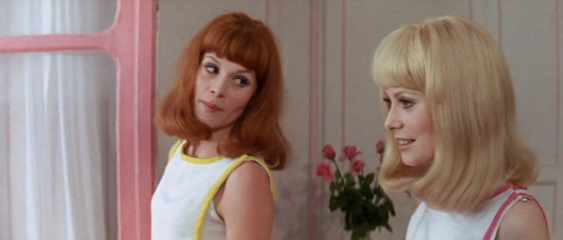
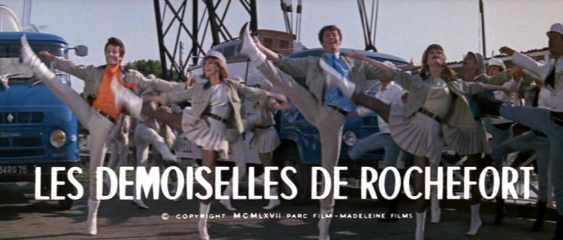
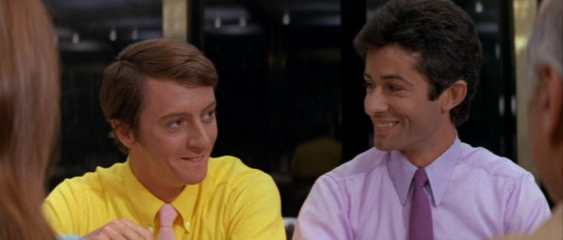
The film wastes no time diving into the world of musicals, following a group of carnies (carnival employees) as they load their trucks and gear onto a sky-bridge. The score moves to a light jazz as they stretch their legs and break out into dance amidst some spectacular overhead shots. Their destination: the Rochefort town square, where a fair will soon be held. Overlooking the square is a studio where the sisters Delphine and Solange Garnier (real-life sisters Catherine Deneuve and Françoise Dorléac) teach kids ballet and piano. Their mother Yvonne (Danielle Darrieux) runs a spacious and airy French fry café in the middle of the square, where the two main carnies Étienne and Bill (George Chakiris and Grover Dale) hang out.
As befits a European food establishment, Yvonne's café is the center of activity for the good citizens of Rochefort. There's Pépé (René Bazart) always at a table working on airplane models, grandfatherly Subtil Dutrouz (Henri Crémieux) lamenting the state of the world, and sailor Maxence (Jacques Perrin) singing songs about his idéal féminin. He's a terrible sailor, more of a painter-poet, and can't wait to be demobbed (discharged) from the navy to search for the girl that he has been dreaming of. But as Étienne and Bill point out, Maxence isn't alone in such aspirations.
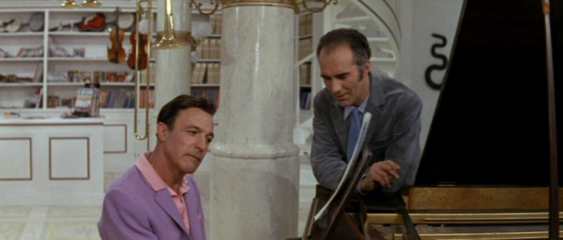
Indeed, practically everyone is out searching for his/her other half in this film. Hang on. Yvonne reminisces about her long-lost love Simon Dame, lamenting that she had to leave him because she couldn't bear to be called Madame Dame. Unbeknownst to her, Monsieur Dame has set up a music shop and promises to recommend aspiring composer Solange (unaware, of course) to his American composer friend Andy Miller. As Solange goes to pick up her little brother Boubou (Patrick Jeantet) from school, she runs smack dab into who else but the very same Andy Miller (Gene Kelly), who awkwardly begins their acquaintance with the line, "Mademoiselle, votre combinaison dépasse" ("Your slip is showing"). Overwhelmed by the encounter, the two of them fail to exchange phone numbers and part ways, each unaware of the other's identity.
Meanwhile, Delphine breaks up her loveless, sex-only relationship with her rich boyfriend Guillaume (Jacques Riberolles), who owns a gallery. As it happens, one of the images in the gallery is Maxence's painting of his dream girl, the spitting image of Delphine. Alas, Guillaume is unwilling to put his ex-girlfriend in touch with this star-struck painter. Back in the square, Étienne and Bill are not having any luck either, as their girls leave them for sailors with blue eyes ("If only your eyes were blue / I could have died for you"). So they recruit Delphine and Solange to dance a number at their carnival booth. There's a montage of characters singing their songs in preparation for the fair, the big day arrives, and all the threads get neatly wrapped up the morning after. Some are cute, some are macabre, some rely on split-second timing right out of Lola, but the end result is several blissful relationships with a bit of wistfully unfinished optimism mixed in.
Homage
All this sounds more than a bit like West Side Story, and not just because George Chakiris plays a leading supporting character. There is, for example, a pre-climatic montage of characters singing about their aspirations. The individual leitmotifs do not mesh quite as well as the carefully-arranged parts to "Tonight" in West Side Story, but there's no question that a big day is coming. Much of the dancing self-consciously imitates the Jerome Robbins style, with kicks and spins aplenty. There are even people playing choreographed basketball to music.
And it's not limited to West Side Story. The whole film is an homage to the American musical, from the slinky red dresses that the twins wear at the carnival ("Won't we look like whores?" worries Solange, but no, more like Marilyn Monroe in Gentlemen Prefer Blondes) to that statesman of the genre, Gene Kelly, who dances his way from Paris with a wide smile on his face. But the French have not had time to hone the form to perfection, and the dancing in Rochefort is noticeably scrappier than the Hollywood musicals of yore.
While the English company providing the dancing in the film is generally well-rehearsed, occasionally you can notice dancers unsure of their footing or looking at the ground for their marks. Any imitation of Jerome Robbins is just that — an imitation, though Chakiris exudes a precision and control that many of the others lack. Gene Kelly is as assured as ever, but even his steps aren't as smoothly choreographed as in his heyday. Some of the actors have obviously not had much experience with lip-syncing. Although most of the major characters do quite well, Deneuve in particular having done Umbrellas previously, Grover Dale stands out in his many scenes with Chakiris by having his mouth open far to wide and his lip sync often off by up to a quarter-second.
But if Fred Astaire and Gene Kelly at their peak are a bit out of reach, the lively dancing adds much enthusiasm and energy to Rochefort. The little numbers performed by the non-dancers have a charm all their own, with the simple choreography giving ample room to the more-important words and music. And what great fun they must have had while writing the lyrics! Lighter in tone than Umbrellas, and with prose being available to carry the plot, the lyrics to Rochefort manage to be both witty and poetic. They laugh at the humor and absurdity of love, and explore the ideal that everyone has a counterpart in the world.
Julian More's English translation is written to the cadence of the songs, and preserves the spirit of the French originals right down to the puns and wordplay. My favorite example is sentimen-men-men-ments, which is translated into English as scandalies-lies-lies-lize. (The French word for a lie or falsehood is mensonge). Of course, this cannot be guaranteed. "Solange, la clé de sol, et la vole des anges." / "Solange, the key of so and the flight of angels" rhymes in French but not in English.
The wit extends to the self-references in the film, the cute little touches that make French films of the New Wave so much fun to watch. Rochefort pokes fun at the New Wave itself, as the two carnies Étienne and Bill are referred to as "Jules and Jim" of François Truffaut fame. Composer Michel Legrand’s score for Rochefort is sometimes brassy, sometimes melodic, with frequent changes of key and scales going up-and-down. It even works its way into the plot, as Solange's unfinished concerto never quite decides what key it ought to be in. And Demy, accused by critics of commercialism for putting an Esso station prominently in Umbrellas, snubs his nose at them with a store selling Kodak film by the square and a large Honda booth at the fair, complete with revolving revving motorcycles.
Happiness
But in-between all the homages and in-jokes is a treatise on love: its serendipity, its capriciousness, its inevitability. The carnies lose their girls, their girls find sailors, but Josette the French-fry stand waitress gets bored with life in Rochefort and joins the troupe with a hankering for adventure. Monsieur Dame promises to connect Solange with Andy Miller, but the twins are unaware of their bonds since they were always away at boarding school when M. Dame was married to Yvonne. Guillaume has a bad-boy streak, shooting guns at paint-filled balloons to create art and driving at hundreds of kilometers per hour, but he really isn't a mean guy, and has no ill will for Solange even as he’s toying with her by keeping Maxence away. There's even an axe murder of a former dancer named Lola-Lola by someone she'd spurned in a prior life (you'll never guess who).
But murder and heartbreak and missed encounters aside, nothing can spoil the good cheer of France's moment under the sun, certainly not with the characters singing such spirited songs. Much of the film is shot outdoors, and buildings are well-lit, with large windows and bright white walls; the centrally-located French fry café is almost a greenhouse with its floor-to-ceiling windows. Streets are filled with miniskirted girls, smartly dressed soldiers and sailors, and townspeople in various pastel colors to match the paint on the buildings. And international affairs do not bother them. Dutrouz may think that "there's trouble everywhere, like in '39," but the twins are blissfully unaware of the Gemini (hah!) space program. Even when Bill reflects back on hard times in Cherbourg at a group dinner in Yvonne's restaurant, the gathering can't help but talk in rhyme.
The actors and actresses have a ball, smiling and laughing and joking throughout the film. The ensemble cast is excellent, although much of the supporting cast is left to their best character acting due to the large number of roles. What do we know about the carnies' girls, for instance, besides their impetuousness? Or of Dutrouz, other than his fixation on the past? And so these characters are played that way, the girls' eyes all-agog over the blue-eyed sailors, and Dutrouz as a grandfatherly "back in the day" figure. But other roles are fleshed out remarkably well, Maxence the painter-poet being played with gentleness and meditation.
The main characters all have their own musical themes, leitmotifs that connect them to other characters when played without words, and that pour out their thoughts when sung. Gene Kelly the Francophile unfortunately can’t speak French except with an stiff American accent, but his songs are dubbed by a Frenchman so they are much easier to understand. Interestingly, the film provides a striking opportunity to observe Catherine Deneuve's star quality. When placed besides her sister, herself a talented actress, somehow Catherine draws the attention. Is it because she's blonde, or because of her softer features, or that ever-present slight curl to her lips that makes her seem both happy and Mona-Lisa mysterious? Well, that's star quality: ineffable, but "I know it when I see it."
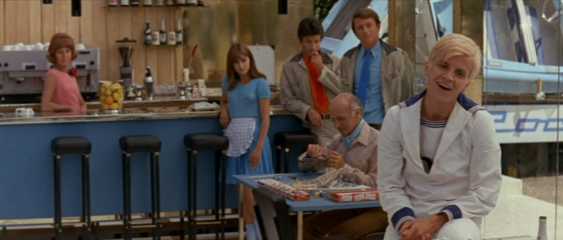
Rochefort presents an idealized world where Maxence can regularly go AWOL to his studio apartment to paint and compose poetry. It is a whimsical environment, where Yvonne gets tired of her last name and tells Simon that she's going to Acapulco. Worries never last for more than a reel, and melancholy is quickly wiped away. Perhaps a little too quickly, as we are reminded at the dinner when Delphine is unhappy with her love life and snaps an angry response to Dutrouz's gentle questioning. Unhappy? Wasn't she just singing? Or perhaps that was everybody else, and we just haven't seen her for a while.
This is the only problem with Rochefort — the emotional undercurrent is too quickly suppressed by the showy tunes. Even the fast-paced argument song between Delphine and Guillaume is infused with little anger or resentment – they end up parting ways amicably, and we spend most of the song chuckling at the puns rather than paying attention to what they're saying. But this quick snapback from emotion is also somewhat intentional. After all, this is a world in which setbacks can be taken with a smile, and love must prevail at the end. It is a helium-balloon of a fantasy, and we're not so much watching a story as floating through a fantasy world of love and song. For a roller-coaster ride on the emotional train, watch The Umbrellas of Cherbourg. For uplift, watch The Young Girls of Rochefort.
Technical
The Miramax DVD is very nice, new elements having been created under Varda's supervision after the successful early-1990s rerelease of The Umbrellas of Cherbourg. If anything, this film looks cleaner and less worn than Umbrellas, due in part to the lesser popularity of Rochefort. Overall, the colors are soft and pleasant pastels, though bright sunlight and indoor lighting often makes Catherine Deneuve look pale. As with many films of this era, the live-action audio is hissy and muffled compared to the studio-recorded music tracks, but there's not much that can done about that now.
Camera moves are fairly complex and generally well-planned to showcase the dance sequences. We even have Gene Kelly driving through the streets while reading music, with only an occasional glance at the road. This is done the modern way – with a towed platform – rather than with the traditional rear-projection.
The film may be a fond artistic homage to Hollywood, but not a technical homage — very little diffusion is used in the photography. Gene Kelly was usually shot with diffusion even in his youth due to the small scar on his left cheek. In this film, without that diffusion, he looks noticeably older than Simon, with whom he's supposed to have gone to school. Interestingly, the large glass windows in Simon Dame's shop seem to be tinted just the right color to match tungsten lighting with outdoor sunshine — the tinting is visible in establishing shots, but from indoors the street looks the right color through the windows and blue through an open door.