Film Review: Shoes of the Fisherman (1968)
The Shoes of the Fisherman (1968)
directed by Michael Anderson
Frames in this review are taken from the 2006 Warner Brothers DVD.
I first stumbled onto The Shoes of the Fisherman by chance as I was organizing a collection of 35mm trailers. As it happens, Shoes has quite a compelling trailer, coming from the period when exclamation-laden title cards began giving way to voice narration. When I heard the tagline about "the first Russian pope," I was hooked. How could such an incredible plot be told without seeming ludicrous? Besides, the film has got Anthony Quinn and Laurence Olivier as the protagonists. Either one of them might do a bad movie for lots of money, but probably not both.
But it never came off my list of films to watch "some day," until the
2005 papal conclave. I was reading one of the better-written news
analysis pieces, from a journalist who actually knows something about the
process. That journalist reminisced about the previous pope, John Paul
II, and recalled visiting then-Cardinal Wojtyla in Poland and looking
over the books in his study. The only piece of fiction on that bookshelf
was Morris West's 1963 novel
The Shoes of the Fisherman
Indeed, Cardinal Wojtyla’s election as pope would be almost as exceptional as the fictional Pope Kiril’s, for John Paul II would not only be the first non-Italian pope in centuries, but also the only pope from a Communist nation. Both would have a gift for languages. Both would be known as intellectuals and be active in reshaping the Church (except John Paul II is much more conservative than the pope in this movie). At the very least, the events in the novel would have been in the back of the minds of some of the Cardinals meeting in 1979.
The Plot
The film version of The Shoes of the Fisherman is a glossy studio picture, starting quite literally with the shiny chrome lettering of the main titles. (Had to be carefully photographed in the pre-digital days.) Incorporating footage from inside Vatican City, intercut with scenes shot on vast soundstages, and dramatized by Alex North's splendid score, Shoes is a feast for the eyes and ears. But beyond the high production values, the film's story is intriguingly intellectual, raising issues about faith, social justice, and the role of the Catholic Church in a rapidly changing world. Kudos to Morris West for raising such questions in a novel, and to the screenwriters for shepherding such themes through a Hollywood screenplay. (The editing could have been tighter, though. There is quite a bit of fluff in the film’s 162 minutes.)
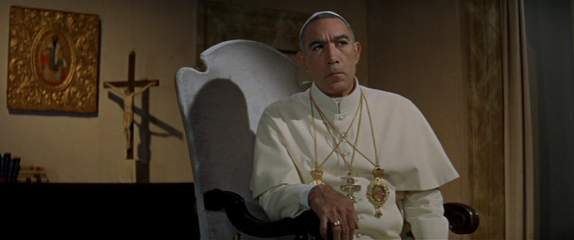
Just how does a Russian become pope at the height of the Cold War? Ah, the American inexactness in geography (e.g., England, Holland) strikes again, for Kiril Lakota (Anthony Quinn) is not Russian, but Ukrainian. Specifically, he was Metropolitan Archbishop of Lvov, Ukraine, until he was banished to hard labor in Siberia to work as a welder on a pipeline. One day, he is unexpectedly summoned by Soviet Premier Kamenev (Laurence Olivier). The two men know each other, and Kamenev possesses a grudging admiration of this man who would not compromise his ideas. Although he is offered release from his sentence, Lakota declares that he would not be a party to any deal.
But it is not his decision to make, as the Vatican has already agreed to the terms and has sent Father David Telemond (Oskar Werner) to Moscow with a diplomatic passport for Lakota. On the plane to Rome, the newly-freed intellectual takes an interest in Telemond's work and is surprised to hear that the Father has been barred from publishing any of his ten manuscripts. On arrival, Lakota is treated to a private audience with the Pope and is created a Cardinal as a reward for his perseverance. Telemond, on the other hand, faces an ecclesiastical council that will pronounce judgment on his unorthodox ideas.
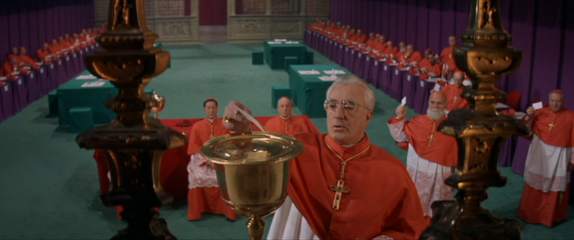
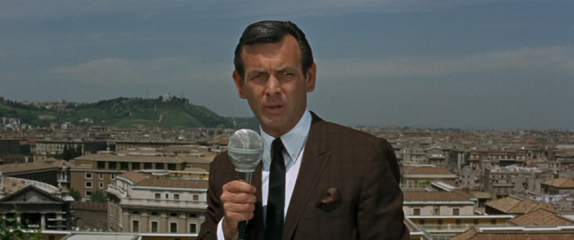
But the Pope dies, and the upcoming inquiry is suspended for the upcoming papal conclave. After several ballots fail to elect a pope, the cardinals are struck by Lakota's eloquence in an informal discussion outside the Sistine Chapel. One by one, they proclaim him pope by acclamation, and a dumbfounded Lakota accepts. "It's the Russian," deadpans the American TV reporter in shock as the new pope appears on the balcony. "The college of cardinals has elected the first non-Italian pope since ... Adrian VI, four hundred years ago." Perfect place for an intermission.
After the (brief) entr'acte, it is time to tackle the problems of the world. China has suffered a series of crop failures and sees no way to forestall widespread famine than to seize the rice bowl countries of Southeast Asia. Premier Kemenev sends a KGB envoy to Pope Kiril, asking for his mediation with Chairman Peng of the People's Republic. But the Chairman wants action, not promises. "Words are cheap," he says, pointing out that the pope will go home to acclaim regardless of the outcome of the summit. "Pay some of the price that we have to pay!" he demands – risk something that is dear to you so that you have a stake in the success of the peace initiative.
Meanwhile, the inquiry bids Telemond to remain silent, and a troubled Kiril delivers the bad news himself. The plot builds up to the magnificent coronation ceremony, during which Kiril halts the proceedings and declares a new policy for the Church. Henceforth, he announces, the Catholic Church will donate all its wealth — its lands, its buildings, its art, its gold — to the relief of the world's hungry and suffering.
Broad Brushstrokes
Realistic? Of course not. The storyline is filled with implausibles. The mere fact of Kiril's election requires several historical traditions to be broken. Today, after seeing the example of John Paul II, it seems prophetic to choose a non-Italian pope from a Communist country. But look at the other events. Kiril is elected pope by acclamation and chooses to reign under his own name – both of which are also unlikely and have not taken place for centuries. (Although it was still possible in 1968, election by acclamation is no longer a valid method of selecting a pope.) To stretch belief even further, the Ukrainian Church is a Catholic but not a Roman Church. The last pope from an Eastern rite church was Zacharias of Greece, who reigned from 741-752 CE.
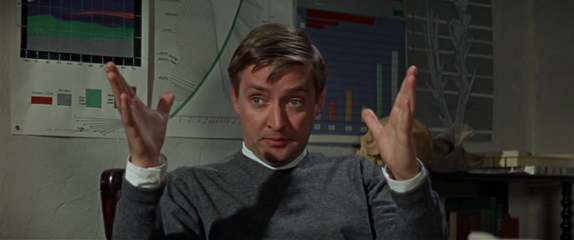
But such implausibles are precisely what give the story its power. Broad strokes on a broad canvas set the stage for sweeping ideas that ask us to suspend disbelief and contemplate weighty moral issues. In a world that is changing so rapidly, is it necessary to cling so rigidly to dogma, or can the Church adapt itself to modernity? At what point does the Church change so much that it has lost touch with its religious roots? The role of raising such questions is handed to the Telemond character, a Renaissance thinker whose study is filled with astronomical and scientific drawings. He espouses unconventional ideas about spirituality, and exceeds the bounds of religion itself, admitting that, even were God not to exist, he would still believe in Man.
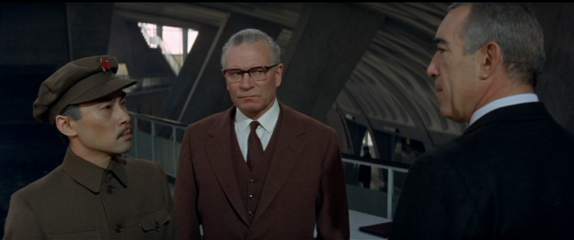
Likewise, the brash young Chairman Peng presents a stark contrast to the older, more accommodating Premier Kemenev, roughly in line with the differing Communist doctrines after the Sino-Soviet split. Yet Peng is no mindless radical, for he points out that he is so willing to compromise that he might well be out of a job after he flies back to Peking. The Chairman decries the Western intervention that has cut China off from its traditional Asian trading partners, but Premier Kemenev counsels small steps rather than overnight changes.
Through their silence, the two European leaders implicitly agree with the validity of Peng's grievances. It is a pragmatic worldview, one that sees actions in terms of cause-and-effect rather than in absolutes of good and evil, one that recognizes that economics may very well force a peaceful people into acts of aggression. Though the story is allegorical, it clearly has contemporary significance, and remains relevant even today. An impressive amount of information is conveyed in a few sparse exchanges during that brief meeting, aided by physical positioning of the characters vis-à-vis each other (two Communists vs. the Pope, two Westerners vs. an Asian, established powers vs. one on the rise).
Taken in the context of the world situation of the 1960s, of the nascent
age of Free Love and birth control, of Paul Ehrlich's
The Population Bomb

Subplots
The film, though, has plenty of flaws. As already noted, it has an
excess of spectacle, unsurprising for a roadshow picture. There is great
attention to detail, as with the lengthy scenes of the ritual events
following the pope's death — placing the room under wax seal, smashing
the pope's personal seals, long lines of cardinals marching into the
conclave, etc. It is marvelous to gaze at the geometry, but one does get
tired after seeing the fourth slow procession (looks a lot like the
first). Edward Carfagno (Ben-Hur

The film also has mixed success when departing from the main plot. One
subplot falls completely flat, as the American reporter George Faber
(David Janssen) tries to work out marital difficulties with his physician
wife Ruth (Barbara Jefford). Given the international nature of the cast,
the reporter helps to ensure some degree of success at the American box
office, but the character also provides an excuse to narrate the
proceedings and explain the conclave process to the viewer in detail.
But marital infidelity is a big cliché of 1960s films, which all seemed
to think that it was the daring thing to do. Shoes doesn't
introduce anything new or interesting into this hackneyed plot point, and
feels not a little like a dress rehearsal for the soap-operatic
Airport
But another subplot, one that is apparently silly and light, brings much warmth to the Kiril character, who previously existed only in terms of political machinations and lofty spiritual ideas. After being elected pope, he sneaks out of the Vatican with the help of his valet, disguising himself as a simple city priest. Going slumming, if you like, although Lakota is quite serious about his duties as bishop of Rome, and feels that he should know the city better. Amidst lover's quarrels, street markets, automobile traffic, and children at play, Kiril is delighted to be soaking up the vitality of everyday life around him.
In yet another implausible occurrence, Ruth Faber nearly hits him in her car while making a house call to a dying patient. But far from being upset or shaken, he offers to help the good doctor in any way that he can. After an episode trying to buy medicine at the corner drugstore without any cash in his pocket, he prays at the man's bedside and is told that the residents are Jewish. Without missing a beat, he begins praying in Hebrew and the Jews join in. Again there are parallels to John Paul II, who has received praise for reaching out to the Jewish community and the world's other religions.
Kiril's visit outside the Vatican symbolizes his intent for the Vatican to engage with the outside world, and extends an earlier sequence of lengthy establishing shots as Kiril is driven around Rome after his flight from Moscow. Here, unlike elsewhere in the film, the scenery is not there just for spectacle, but actually mean something. These shots add to our understanding of a man who had lived in icy Siberia for a decade, someone with a curiosity and a zest for life that has been denied to him for so long. Furthermore, his desire to be just a shepherd tending his flock sets up his later decision to return the church to its humbler roots of the first century CE.
The acting is excellent and helps to suspend the viewer’s disbelief at events. Oscar Werner stands out as the intellectual cleric who is at odds with his Church, conflicted and desperately trying to reconcile his beliefs. Anthony Quinn makes for an unlikely Pope but gives just the right character to Kiril, a character who is a bit unsure of himself after years in a labor camp. Burt Kwouk's Chairman Peng is straightforward and insistent, but Laurence Olivier loses much of his commanding edge by affecting a Russian accent. One gets the impression that some of the energy that he normally puts into emphasis and expression was instead channeled towards rolling his r's. David Janssen's reporter is resolutely American, with a the twang in his voice and a solemn delivery appropriate for the age of the network news.
The Shoes of the Fisherman is a fascinating film that dramatizes the much-watched but normally-unseen process of a papal conclave, while tackling several difficult issues of the 1960s. It is hard to match in terms of relevance. However, 162 minutes is simply too much spectacle. For example, there's not much tension that builds up during Father Telemond's inquisition, since it is interrupted by the papal conclave and by lengthy spectacles. By the time the inquiry is actually held, we’re just surprised that he’s still in the picture.
Details
The Shoes of the Fisherman also provides some interesting historical notes when viewed in a modern context. During the 2005 papal conclave, there was much talk about the changing geographical face of the Catholic Church, as in The New York Times' Flash graphic. The 1958 and 1963 papal conclaves included a cardinal each from the Soviet Union and from China (the Vatican recognizes the ROC rather than the PRC). Shoes features a Ukrainian cardinal who gets elected pope, and one of the scrutineers during the balloting clearly looks East Asian. As the cardinals arrive for the conclave, there is a disproportionate emphasis on the on the African and Eastern cardinals, a hint of how diverse the Church is slowly becoming.
At the time of the film, popes still referred to themselves using the majestic plural (“we” rather than “I”), and were carried in a chair to be crowned. Both of these practices have since ended. Faber, in fact, points out to the television audience that there has been criticism of the lavish coronation ceremony. The role of individual conscience in conflict with Church rules has become a fracture point today, and is interesting when applied to the liberalizing Vatican II church of the 1960s.
The DVD is a solid transfer, with good colors. The red of the cardinals pops out amid a dark background, and the copious amounts of gold glitter in the light. The Lenin statues and paintings do seem a bit too much for the Soviet and Chinese control rooms, but this is more of a fable than a speculative history, anyway. The stock footage of crowds and faces in St. Peter's Square match reasonably well against the staged shots, with the lower color saturation being the main giveaway.
Music
The music in this film is worth mentioning separately. Prior to working
on this film, composer Alex North had just been kicked off
2001: A Space Odyssey

Fortunately, Fisherman came along at just the right moment to lift him from his post-2001 dejection and also happened to offer a subject that was eminently suitable for a reworked version of North's Zarathustra drop-in from 2001. Kubrick's film, after all, deals chiefly with the evolution of the human mind and spirit, and uses space exploration only as a backdrop. It is not much of a leap from the Superman to the Star-Child to the Pontifex Maximus, God's representative on Earth. North's modernized Wagnerianism evokes the majesty of the Church and the spiritual ambitions of Man. He recovered in fine style, and both 2001 and Shoes have benefited. The modern scores work better here than they would have in 2001, and they supply an undercurrent for the theme of the Church's role in the modern world.
There are also some incidentals done in a popular modern (1960s!) style, but these are not nearly as memorable as the multiple arrangements of a Ukrainian folk ballad. Transported to a one-hundred piece symphony orchestra, the ballad's vaguely eastern strains become wistful, or lyrical, and yes, majestic. The score to Fisherman is certainly not as famous or as talked-about as the adapted classical music used in 2001, but it is also quite memorable and also more melodic. When brought together, North's score smooths the transitions, punctuates the major events, and brings an excitement to Shoes that sets it firmly in the day-to-day developments of the modern world (of 1968).